Seismographs in Ariccia – ARIC Seismic Station
Real-time seismograms from the seismographs of the ARIC seismic station in Ariccia, located in the volcanic district of the Alban Hills (Castelli Romani), Rome, Italy. The station represents an advanced local seismic monitoring system, designed for the real-time detection and analysis of ground vibrations.
Also watch our Live streaming on YouTube
Seismograms
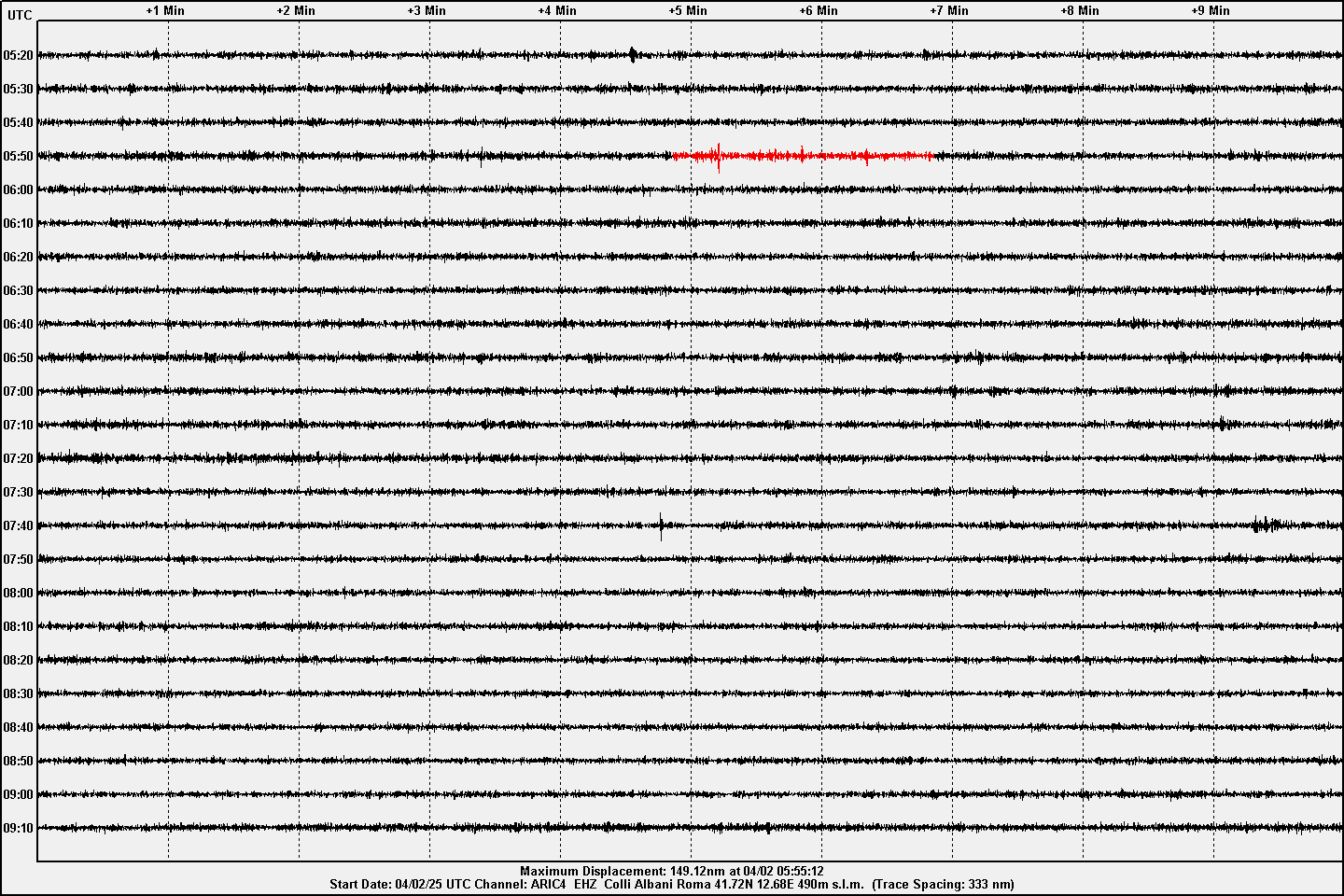
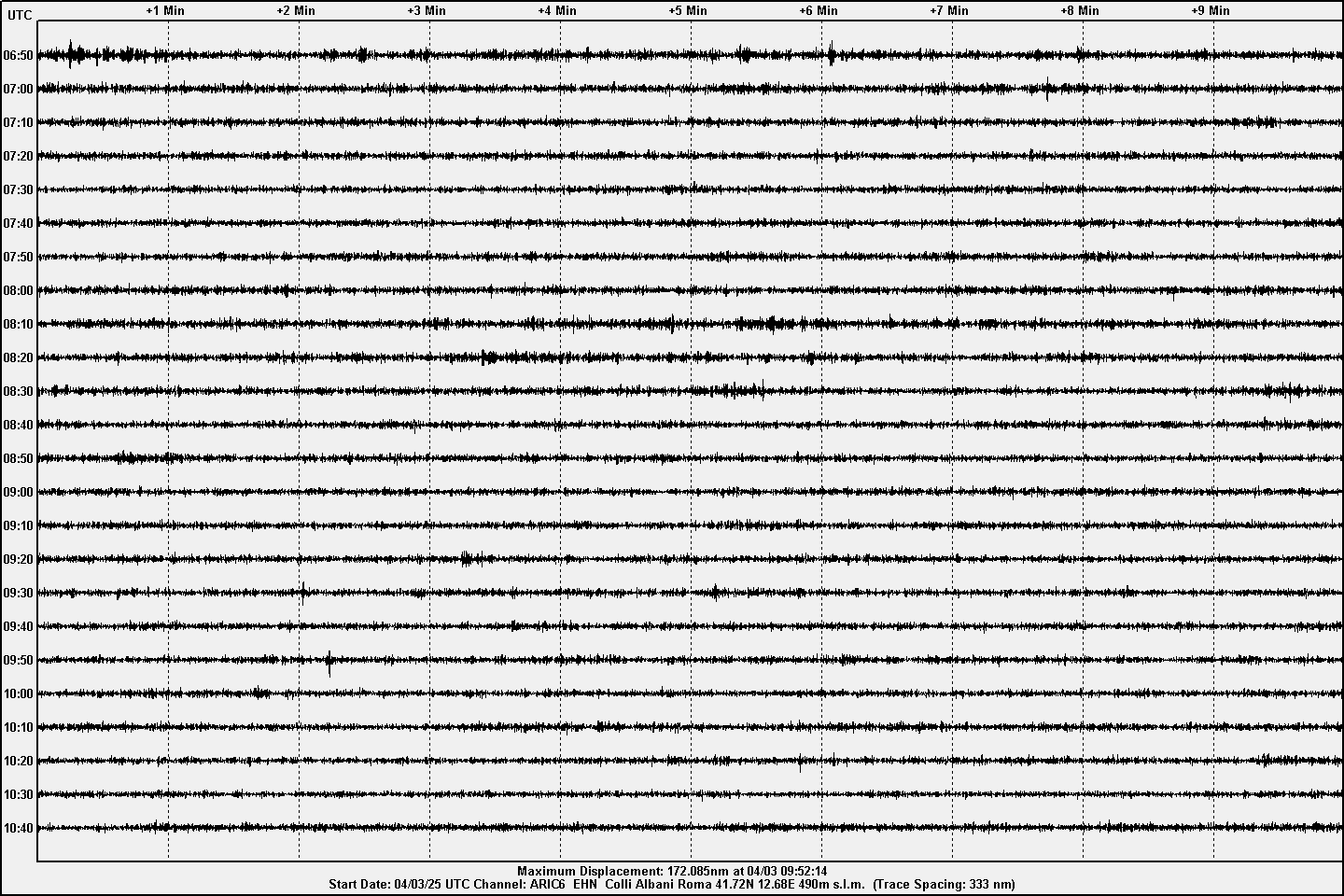
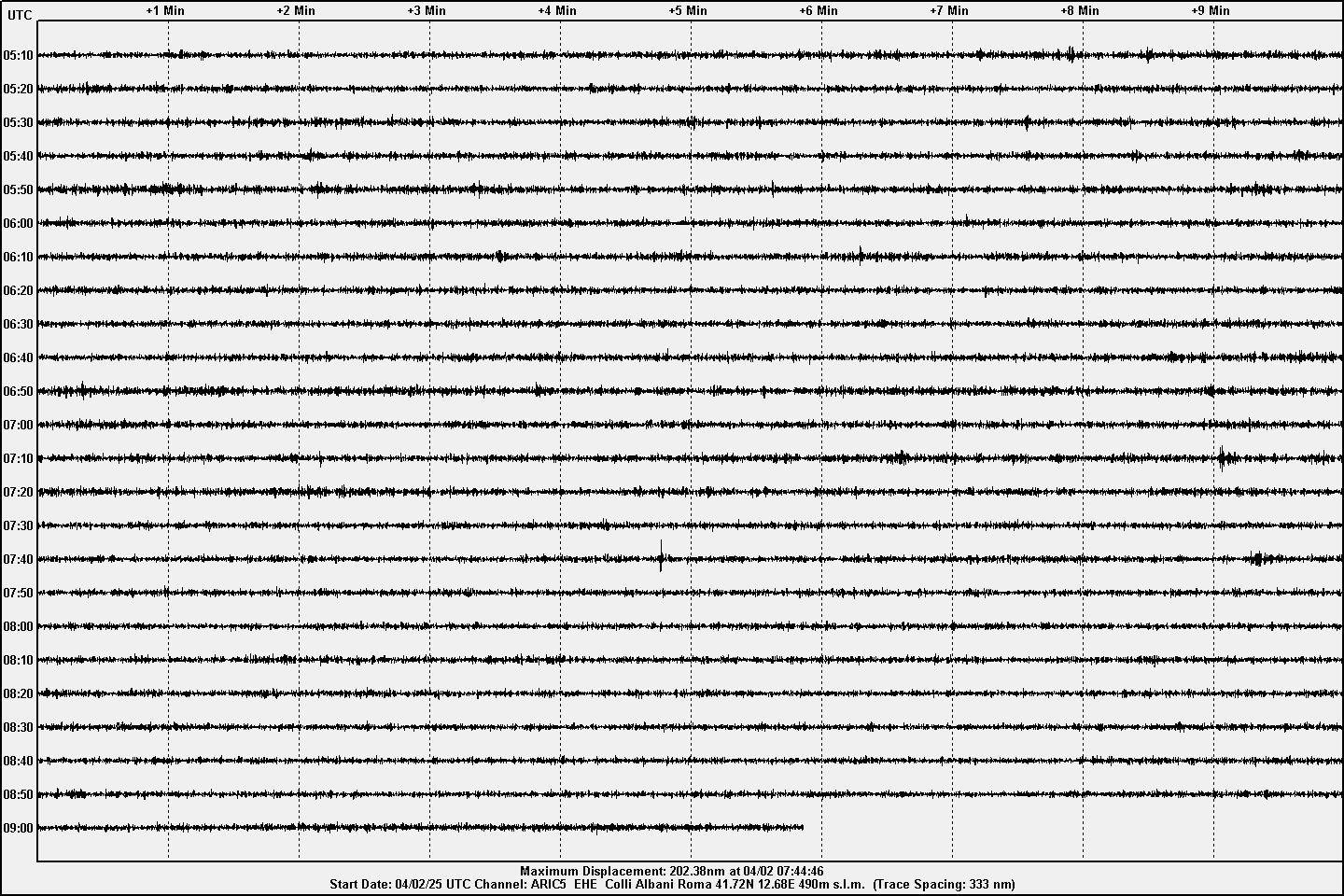
The images show the scientific data recorded by the seismic station of the Castelli Romani. The real-time signal from the seismic station is also sent to the YouTube Live stream.
Channel #3 shows the Z axis of the seismogram, the vertical component of ground displacement.
Channel #1 shows the N/S axis of the seismogram, the horizontal component of ground displacement.
Channel #2 shows the E/W axis of the seismogram, the horizontal component of ground displacement.
Reading the Seismogram
The ground is always subject to continuous and imperceptible movement, with the amplitude of the seismic trace varying according to ground displacement, mostly due to microseisms, microtremors, and anthropogenic noise.
Occasionally, seismic events appear in the trace, with earthquakes of varying significance depending both on their amplitude and their distance from the station, mostly instrumental events not felt by the population.
The vertical scale of the seismograms (drum) is linear, with the scale factor indicated in the graph.
The times shown are strictly UTC. For Italian local time, add 1 hour to the time shown in the diagrams during standard time (winter), or 2 hours when daylight saving time is in effect (summer).
Some Station Data
The ARIC seismic station broadly comprises three ultra-high-sensitivity Class A seismic sensors (2543V/m/s), digitizers, seismic acquisition and analysis software, servers with data distribution software, a dedicated seismic vault to house the seismometers, and autonomous power supply.
The resolution of the Class A seismometers used is approximately 3 Ångström (0.3 nm), with measured intrinsic noise equivalent to less than this value within the seismic band used.
This level is of the same order of magnitude as the distance between two oxygen atoms in adjacent water molecules, or alternatively twice the covalent radius of a zirconium atom.
This result is due not only to the use of highly selected professional components, but also thanks to and in recognition of senior physicist Chris Chapman of the University of Oxford, for his fundamental contribution to the development.
The seismic signal undergoes further processing before being displayed in the seismogram.
It is worth noting the deliberate and intentional suppression, together with a significant portion of oceanic microseisms, of seismic waves with long periods. This decision was made to avoid the overlap of strong distant earthquakes, known as teleseisms, which produce oscillations of such amplitude that they would prevent the immediate visualization of weak local and regional earthquakes, which are instead the specific focus of this seismic station.
Such enormous oscillations can last for hours and fill entire seismograms, for example in educational seismographs used in schools, or in research instruments of the GSN – Global Seismographic Network. In some cases, very slow seismic waves of lower amplitude remain stationary for days when the entire planet enters oscillation in the normal modes. This filtering does not prevent the primary waves of strong teleseisms from appearing in the seismograms.
The displacement of the ground relative to the inertial mass of the seismometers ultimately generates the digital trace, visible in the seismogram, with a scale factor of 6 nanometers for each pixel represented.
The UTC time, synchronized with reference to the average of atomic clocks, is disciplined by GPS. An autonomous NTP server is used, specifically dedicated to maintaining UTC(k) time in near real time, exclusively for the seismic instrumentation.
The ζ damping ratio used in the seismometers is higher than the critical value, in order to reproduce, as far as possible, the exact movement of the ground without adding further distortions, which have nevertheless already occurred during the natural propagation processes of seismic waves.
The instruments are also subject to periodic calibration checks to ensure the declared scale factor. This measure allows the automatic and instantaneous calculation of Magnitude, with a deviation of ± 0.1 ML at a confidence level of 68%.
The scale factor in the displayed seismograms can be varied as required.
Please Note
Every year, the ARIC seismic station records thousands of events. The seismograms are only the simplest and most visible part of the seismic station. Both spectral analysis and detailed information for each seismic event are available. Details of any recorded event are available, upon justified request, in standard seismic format. Some events not detected by other seismic stations may be provided only after careful analysis at our discretion. Raw data details for each seismic event above a predefined threshold are automatically sent in real time to the IESN network.
Final Note
MeteoAriccia does not sell or build seismometers on behalf of third parties, does not provide consulting services, and does not offer seismic forecasts and/or assessments of any kind. Simple measurements are catalogued and recorded exclusively for scientific and/or educational and entertainment purposes, within the available limits.
The data are provided “as is” without any implied or explicit warranty.
Use of the provided data is entirely the responsibility of the user, who releases both MeteoAriccia and the webmaster from any liability.
Acknowledgements
- Chris Chapman, Senior Physicist at Oxford University
- Larry Cochrane Seismic Data Acquisition and Recording up to 500 SPS
- Larry Cochrane Datalogging Software
- Sara electronic instruments, seismic acquisition software and data transmission
- Larry Cochrane, software for seismic analysis
- Francesco Nucera, I.E.S.N. Seismic Network